Configuration
Web Configuration
Primary surfaces (write):
| Task | Where |
|---|---|
| Live status (read) | HTTPS portal at https://<host>/ |
| Services, networking, packages | Cockpit at https://<host>/admin/ |
| Upstream CoT lanes (mesh / TAK Server / tools) | Cockpit → Charontak → /etc/charontak.ini |
Feeder tuning (adsbcot, aiscot, lincot, …) |
Cockpit feeder apps + /etc/default/* |
| WiFi join / hotspot recovery | Comitup at http://<host>:9080/ |
The Node-RED Dashboard at :1880/ui is deprecated for configuration. It remains for maps, TFR injection, and optional recorder logging only. See node-red.md.
After changing Charontak lanes in /etc/charontak.ini or advanced feeder defaults, restart the affected units:
sudo systemctl restart charontak adsbcot aiscot lincot dronecot
(Add aircot if enabled on your image.)
Many functions of the AryaOS can be controlled, configured and monitored via the AryaOS Web page. When connecting directly to the AryaOS in Hotspot mode (via AryaOS-XXXX WiFi, same XXXX as hostname aryaos-xxxx) you can access the AryaOS Web page at http://aryaos-xxxx.local/ or https://aryaos-xxxx.local/ (portal). Before first-boot personalization the factory hostname is aryaos (http://aryaos.local).
Connect to WiFI
N.B.: If you are connected to AryaOS via the WiFi Hospot (AryaOS-XXXX), reconfiguring the WiFi to connect to another network will terminate your Hospot connection. To reach the AryaOS Web page after this point, you'll need to connect to the same network as AryaOS.
- Connect to the AryaOS WiFi network and browse to http://AryaOS.local
- Click the WiFi configuration option.
- Enter WiFi credentials and apply.
Reset WiFi
Use the AryaOS web portal (when connected to the device) or re-flash / follow network recovery steps in Troubleshooting. Advanced deployments may use Cockpit or SSH with tools shipped on the image.
Disable WiFi
Disable or reconfigure wireless interfaces from Cockpit (Networking), NetworkManager, or SSH using the same tooling as upstream Raspberry Pi OS. Exact steps depend on whether you use hotspot mode or client WiFi.
Change TAK / CoT destination (summary)
Local *cot feeders read COT_URL from /etc/aryaos/aryaos-config.txt (default udp+wo://127.0.0.1:28087 → Charontak). Upstream mesh, TAK Server, and tool fan-out lanes belong in /etc/charontak.ini (Cockpit → Charontak). For command-line edits and service restarts, see Command-line Configuration → Change TAK / CoT Routing below.
Command-line Configuration
For advanced users. These steps require familiarity with command-line terminals using SSH.
Change default password
The AryaOS image contains a user with a default password. It is recommended that the owner of AryaOS gateway change this password.
To change the default password:
- SSH into AryaOS:
ssh pi@AryaOS.local - Change the password:
passwd
Please make note of this password. There is no password recovery feature.
See also: Raspberry Pi Insecure first user
Change TAK / CoT Routing
AryaOS uses a two-tier CoT routing model:
- Local feeders (
adsbcot,aiscot,dronecot,lincot, …) readCOT_URLfrom/etc/aryaos/aryaos-config.txt. The image default sends CoT to Charontak onudp+wo://127.0.0.1:28087. Keep this value in place for normal AryaOS deployments. - Charontak listens on
udp+ro://127.0.0.1:28087, reads/etc/charontak.ini, and forwards the same local feeder stream to Mesh SA, a TAK Server, another local tool, or multiple destinations. Manage lanes via Cockpit → Charontak athttps://<host>/admin/(restartcharontak.serviceafter saves).
Default Charontak egress is udp+wo://239.2.3.1:6969 (Mesh SA) through the enabled local-to-mesh lane. Node-RED and other mesh listeners continue to use that group.
CoT routing COAs
| COA | Use case | Feeder COT_URL |
Charontak lanes |
|---|---|---|---|
| Default Mesh SA | Offline / local MANET / tablets listening to multicast | udp+wo://127.0.0.1:28087 |
Enable local-to-mesh: udp+ro://127.0.0.1:28087 → udp+wo://239.2.3.1:6969 |
| TAK Server only | Appliance sends all sensor CoT to one TAK Server | udp+wo://127.0.0.1:28087 |
Disable local-to-mesh; enable local-to-takserver: udp+ro://127.0.0.1:28087 → tls://<takserver>:8089 or tcp://<takserver>:8087 |
| Mesh SA + TAK Server | Local tablets see Mesh SA while upstream also receives the same CoT | udp+wo://127.0.0.1:28087 |
Enable both local-to-mesh and local-to-takserver |
| Other local tools | Feed a recorder, processor, or sidecar without touching individual sensor daemons | udp+wo://127.0.0.1:28087 |
Add another lane from udp+ro://127.0.0.1:28087 to that tool's CoT URL |
| Legacy direct feeder routing | Debug or bypass charontak entirely | Set each feeder directly, for example udp+wo://239.2.3.1:6969 |
Disable charontak.service; this is not the normal AryaOS pattern |
Feeders only (advanced): edit COT_URL in /etc/aryaos/aryaos-config.txt only when intentionally bypassing charontak, then restart the gateway units (for example sudo systemctl restart adsbcot).
Upstream TAK Server / extra lanes: edit /etc/charontak.ini in Cockpit Charontak or with sudo nano /etc/charontak.ini, then sudo systemctl restart charontak. A disabled local-to-takserver lane template is shipped for TAK data package / enrollment URL imports; enable it and set egress_cot_url (and TLS paths) as needed.
Legacy direct multicast: to bypass Charontak entirely, set feeder COT_URL=udp+wo://239.2.3.1:6969 in aryaos-config.txt and disable charontak.service.
1090 MHz ADS-B decoder (readsb vs dump1090-fa)
readsb SDR backends (image default): the pi-gen image rebuilds readsb with RTL-SDR, SoapySDR (Airspy and other Soapy devices), and native HackRF. Check on a running host:
readsb --help 2>&1 | grep -iE 'RTL-SDR|Soapy|HackRF'
Runtime helpers (SSH on the gateway):
| SDR | Script |
|---|---|
| RTL-SDR (EEPROM serial) | scripts/readsb-use-rtl-serial.sh |
| Airspy (Soapy) | scripts/readsb-use-airspy.sh |
| HackRF (native or Soapy) | scripts/readsb-use-hackrf.sh |
Only one of readsb and dump1090-fa may be enabled at a time: the image ships systemd Conflicts= drop-ins and enables readsb by default while dump1090-fa stays disabled.
Unified JSON feed: both decoders write /run/adsb/aircraft.json. adsbcot always uses FEED_URL=file:///run/adsb/aircraft.json — you do not change FEED_URL when switching decoders. The directory is set in ARYAOS_ADSB_JSON_DIR in /etc/aryaos/aryaos-config.txt (default /run/adsb); readsb uses it via ADSB_JSON in /etc/default/readsb.
Image / Ansible: set aryaos_adsb_decoder in vars.yml to readsb or dump1090_fa. For pi-gen, export ARYAOS_ADSB_DECODER_DEFAULT=dump1090_fa during the build if you need dump1090-fa enabled instead of readsb.
Runtime switch (example — use dump1090-fa): sudo systemctl disable --now readsb then sudo systemctl enable --now dump1090-fa, then sudo systemctl restart adsbcot. Reverse the steps to return to readsb. No FEED_URL edit is required.
Upgrading an older image that used /run/readsb/aircraft.json:
sudo sed -i 's|^ADSB_JSON=.*|ADSB_JSON=/run/adsb|' /etc/default/readsb
sudo sed -i 's|^FEED_URL=.*|FEED_URL=file:///run/adsb/aircraft.json|' /etc/default/adsbcot
sudo systemctl daemon-reload
sudo systemctl restart readsb adsbcot
The value ARYAOS_ADSB_DECODER in /etc/aryaos/aryaos-config.txt documents which decoder should be enabled; toggling services is still required when changing decoders on a live system.
Change dump1090-fa & dump978-fa SDR serial numbers
Pre-assembled AryaOS devices use a factory pairing: 1090 MHz traffic uses serial stx:1090:0 on readsb (default) or dump1090-fa if you select that decoder at build time — not both. 978 MHz UAT goes to dump978-fa on stx:978:0 (Nooelec NESDR Nano 3 “978” sticks ship with that UAT preset). The 1090 and UAT serials must differ; the Ansible image build fails if adsb_sdr_sn and uat_sdr_sn are equal.
On a running system you can override the UAT binding without editing /etc/default/dump978-fa by hand:
- Edit
/etc/aryaos/aryaos-config.txtand setARYAOS_UAT_RTL_SERIAL=to thertl_testserial string for your 978 dongle. - Restart the service:
sudo systemctl restart dump978-fa
(Each start runsapply-dump978-serial.sh, which merges that value into/etc/default/dump978-fa.)
When you plug in a Nano 3 programmed as stx:978:0, udev may systemctl try-restart dump978-fa automatically (see /etc/udev/rules.d/99-aryaos-dump978-uat-rtlsdr.rules). If your kernel exposes a different ATTRS{serial} string, adjust that rule using udevadm info -a on the device path under /dev/bus/usb/.
You may still need to change dump1090 / dump978 serials manually (sections below) if:
- Using a self-assmbled AryaOS device.
- There is need to change these values (for example, replacing an SDR).
An AryaOS Web Dashboard method of doing this is under development. See Issue #21. Until then use SSH, Cockpit file editor, or scripts/readsb-use-rtl-serial.sh.
cockpit-lincot: LINCOT v1.2.0 ships the daemon and /etc/default/lincot defaults; a cockpit-lincot .deb was not published on the v1.2.0 GitHub release — edit lincot defaults via Cockpit generic file editor or CLI until packaging lands.
Changing dump1090-fa SDR serial number
- SSH into the AryaOS:
ssh pi@AryaOS.local - List the serial numbers of the installed SDRs by typing the command:
rtl_test
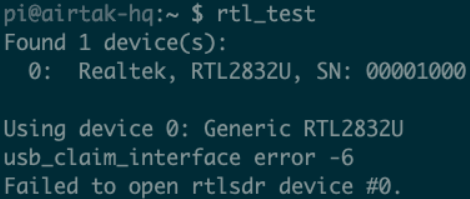
- Using the Nano text editor, open the dump1090-fa configuration file:
sudo nano /etc/default/dump1090-fa

-
Find the line beginning with RECEIVER_SERIAL and change the value to match the SN value from the rtl_test command above.
-
Reload and restart dump1090-fa:
sudo systemctl daemon-reloadsudo systemctl restart dump1090-fa
Changing dump978-fa SDR serial number
Preferred: set ARYAOS_UAT_RTL_SERIAL in /etc/aryaos/aryaos-config.txt to the value from rtl_test, then sudo systemctl restart dump978-fa (see Change dump1090-fa & dump978-fa SDR serial numbers above).
Alternative (direct file edit):
- SSH into the AryaOS:
ssh pi@AryaOS.local - List the serial numbers of the installed SDRs by typing the command:
rtl_test - Using the Nano text editor, open the dump978-fa configuration file:
sudo nano /etc/default/dump978-fa - Find the line containing
driver=rtlsdrand set theserial=field to match your 978 SDR’s serial fromrtl_test(see comments in the file for examples). - Reload and restart dump978-fa:
sudo systemctl daemon-reload
sudo systemctl restart dump978-fa
Cockpit: the AryaOS admin surface
All administration happens in Cockpit at https://<host>/admin/:
- AryaOS Site (cockpit-aryaos) — site-wide settings in
/etc/aryaos/aryaos-config.txt: the siteCOT_URL, ADS-B decoder selection, UAT serial, and site-wide TAK TLS certificates (PEM upload to/etc/aryaos/tls/, wired toPYTAK_TLS_CLIENT_CERT/KEY/CAFILE; the key is group-readable viatak-certs). Every gateway unit inherits the site config viaEnvironmentFile=; per-service values override it. - Per-tool plugins (from the snstac apt repo) — cockpit-adsbcot, cockpit-aiscot,
cockpit-lincot, cockpit-dronecot, cockpit-aiscatcher, cockpit-gps: service control plus
per-service config (
/etc/default/<svc>) and per-service TLS overrides. - SiKW00FCOT (sikw00fcot) — installed as
sikw00fcot.servicefor SiKW00F MAVLink fan-out to CoT. It inherits the AryaOS siteCOT_URLfirst, so the default route is through Charontak; edit/etc/default/sikw00fcotfor SiK-specific values such asMAV_URL.
GPSTAK: Network GPS for ATAK / WinTAK
gpstak feeds the onboard GNSS to TAK devices so tablets can use
the sensor's GPS as their own position source: CoT position events to COT_URL
(default udp+broadcast://255.255.255.255:4349 — ATAK's External or Network GPS port)
plus optional raw-NMEA passthrough for WinTAK (NMEA_TARGETS). PyTAK-style config in
/etc/default/gpstak; ships disabled — enable and configure in Cockpit → GPSTAK.
On the ATAK device: Settings → Device Preferences → GPS Preferences →
External or Network GPS. See https://ampledata.org/network_gps.html.
LINCOT: Host Beacon Remarks And Accuracy
lincot sends the gateway's own host beacon to TAK. AryaOS keeps its COT_URL pointed
at Charontak and sets GPS_INFO_CMD="gpspipe --json -n 5", so the beacon position comes
from the local gpsd TPV fix. LINCOT v1.3.1+ maps gpsd accuracy into CoT point fields:
hae from altHAE when present, ce from eph or sqrt(epx^2 + epy^2), and le
from epv.
AryaOS also sets REMARKS_EXTRA_CMD=/usr/local/sbin/aryaos-lincot-remarks. LINCOT runs
that helper for each host beacon and appends a concise host environment snapshot to the
remarks: CPU/load, RAM, swap, root disk, temperature, uptime, and Raspberry Pi throttle
state when available.
For AryaOS-to-AryaOS discovery, the same LINCOT beacon also runs
COT_DETAIL_XML_CMD=/usr/local/sbin/aryaos-cot-detail. That helper emits a structured
<__aryaos> CoT detail block. aryaos-neighbord.service listens on Mesh SA
239.2.3.1:6969, caches those beacons in /run/aryaos/neighbors.json, and the portal
serves them from /cgi-bin/aryaos-neighbors. If a node has no current GNSS fix and
LINCOT is not emitting its normal host beacon, aryaos-neighbord sends a low-rate
status-only CoT beacon with a no-fix point so other AryaOS boxes can still show its
hostname, services, roles, and admin link.